Listening to economists speak is seldom an occasion for laughter. The seriousness of their subject resists humor, for they concern themselves with a fundamental question that is both severe and inexhaustible: how best to utilize limited resources so as to satisfy, as fully as possible, the unlimited desires of modern humans?
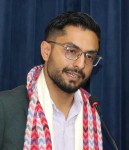
Yet, at an interaction hosted by Nepal Council of World Affairs earlier this year on the shifting dynamics in global economic order and their implications for Nepal, the economist Bishwambher Pyakuryal momentarily set aside the gravity of the subject. With disarming humor, Professor Pyakuryal, who is also a former diplomat, confessed that his presentation on the subject had been assembled in haste, with the PowerPoint he was going to show itself put together by his son carefully putting his thoughts and ideas into slides while connected with him remotely from halfway around the world.
Almost immediately, former Governor of Nepal Rastra Bank Deependra Bahadur Kshetry offered a playful jab from the dais itself. He wondered whether the “son” mentioned by Professor Pyakuryal might, in fact, be an AI. A brief, uneven laugh passed through the room, while the Professor’s own expression betrayed a slight annoyance. The programme quickly assumed the expected seriousness of the subject at hand. Yet the friendly banter between the two economists proved to be as pertinent and pressing as the rapidly shifting global economic patterns they explained through data and graphs or the hypothetical political and economic scenarios they projected for Nepal as a result of it. For it clearly and undoubtedly pointed towards the now-rampant use of generative AI systems like ChatGpt to generate, just from a few instructional prompts, everything from clear-worded emails, briefs, speeches, slogans, and summaries to complex analysis, PowerPoint presentations, and from newspaper articles, edited pieces and near-perfect translations to something as complex as poetry, fiction, and essays (like this one—minus the real-world exchange between the economists). In short, AI has begun producing nearly all forms of writing that humans produce, read or use on a daily basis for various purposes.
Here I focus entirely on the human discipline of writing itself: a system of letters, syllables and words through which we create meaning, record knowledge and transmit information. This is distinct from other creative domains such as visuals (both static and moving), songs and music, choreography, coding, fashion, architectural designs, and more — that large language models like ChatGpt, Gemini and other AI systems are increasingly able to reproduce with striking effectiveness.
Nothing rivals the “time machine” effect of writing as it is the only invention that allows a person from two thousand years ago to speak directly into our mind today. Writing conquered time and space. Perhaps this is why the closest Sanskrit word for “letter” or “syllable” is Akshara -- that which doesn’t perish, the indestructible.
Writing is arguably the most transformative invention in human history, marking the true beginning of ancient civilizations. First appearing as Cuneiform in Sumer in 3400 BCE (in modern-day Iraq), writing initially served a practical purpose: keeping accounts of such mundane but essential things as grain, barley, livestock and tax. Overtime, however, it evolved into an almost involuntary act to store data, memory, and other information outside the human brain. Writing gave durability to knowledge, ensuring that it didn’t perish with the individual or drift through oral tradition. Through writing, various civilizations developed scripts, which in turn helped codify laws, built religions and made long-distance communication possible. With writing, human history began in earnest.
Kings and empires rose and fell, but the thoughts, memories, music, songs, stories and poetry outlived them. They travelled with people as migrants, influenced other cultures and civilizations, helped establish global religions, and fundamentally rewired the human brain and shaped the course of history. Without writing, there would have been no Bhagavad Gita, Bible or Koran; no artistic, scientific or industrial revolutions nor political revolutions such as the magna carta, French revolution, American Declaration of Independence and the communist revolution —and certainly not the ongoing IT and AI revolution shaping our present.
Some historians may argue that other inventions such as the control of fire, spoken language, or agriculture (which “domesticated” us by allowing to settle long enough to invent writing) deserves the title of humanity’s most transformative breakthrough. Yet nothing rivals the “time machine” effect of writing as it is the only invention that allows a person from two thousand years ago to speak directly into our mind today. Writing conquered time and space. Perhaps this is why the closest Sanskrit word for “letter” or “syllable” is Akshara -- that which doesn’t perish, the indestructible.
Writing was one of humanity’s earliest information technologies. Much later, it led to the invention of paper, which made knowledge portable. This, in turn, created the need for the printing press, and Gutenberg’s revolution of 1440 enabled mass literacy and scientific exchange. Centuries later came personal computers, followed by the internet, which quite literally formed a “world wide web” - a global nervous system by 1991. Smartphones soon followed placing supercomputers in every pocket.

Then, towards the end of the year 2022, just as the world was beginning to recover from the devastating coronavirus pandemic that killed millions and disrupted daily life, ChatGPT was introduced to the world without grand fanfare or hype. I am not trying to draw any causal connection between these two transformational events, but it felt like as though the world had gone into a kind of hiding, a gestation only to give birth to the AI revolution that rapidly exploded into global awareness. Within days, ChatGPT reached one million users—a pace previously unseen in consumer technology—and by early 2023 it had surpassed one hundred million users, becoming the fastest-growing consumer tech product in history. Users were both surprised and fascinated by its ability to converse fluently, help them write emails and articles, explain complex ideas, generate striking images and what we call “creative content” to make their day-to-day work easy.
I am not trying to examine how ChatGPT, Gemini and other AI systems are reshaping the world of work or eliminating entry level jobs. Instead, I am focusing on something more fundamental: how AI has altered writing itself – the “mother invention” that made nearly everything else possible, including AI itself.
To make sense of the present, we sometimes need to look to the past. The invention of the camera in the early 19th century was widely believed to spell doom for realistic portrait painters who worked in royal courts and public squares across Europe. Many predicted that painting itself would soon become obsolete. History proved otherwise. Artists and writers have been able to repeatedly overcome many problems that allowed their art form not merely to survive, but to endure for centuries, even millennia. As the saying goes, the present may belong to monarchs, conquerors, and merchants, but ages are defined by art, philosophy, and poetry. In response to the existential threat posed by photography, artists came up with new modes of expression such as surrealism, impressionism, cubism that revolutionized not only painting, but our very perception of reality. Artists such as Pablo Picasso and Salvador Dali experimented with mixed media, blending the elements of painting, photography, and movement to create some of the most poignant and resonant works of arts. At the same time, the structural transformation in the world of art that was triggered by the camera elevated photography itself—from a technical curiosity involving large metal boxes and light-sensitive paper into one of the most influential art forms of the modern age. And much as the camera and photography did for painting, AI threatens the ancient vocation of writing—only, perhaps, to ultimately enhance it.
The birth of any powerful new technology is inevitably disruptive. People are skeptic at first, but it soon spirals down to outright fear and even hostility. It is therefore unsurprising that some pioneers in the field are predicting and even warning against a dystopian future marked by a complete AI domination in all fields of human endeavor. That it will subjugate our human race or annihilate us altogether, an event marked by technological singularity when AI becomes vastly superior than humans. However, humans are profoundly adaptive and self-aware beings, possessing the innate capacity to responding to the very predictions made about themselves (even by themselves) and, by that very act, alter the trajectory of their respective and collective fates and change the entire course of human history. This makes such deterministic and detrimental forecasts about AI – much like astrology – far less likely to come true.
Mr. Gurung is a writer, former journalist and communications professional. He can be reached at: [email protected]