By Professor Pramod Shrestha
KATHMANDU, December 5 — The call came on a September morning in 1999, when a voice from Nepal Television broke the usual academic routine. Mr. Rana spoke of an invitation from the Asian Broadcasting Union (ABU) for Nepal to participate in something we never thought possible: the International ABU Robotics Competition. As Head of the Mechanical Engineering Department, I held the phone with a quiet confession—I knew very little about robotics.
But uncertainty often fosters curiosity. During a regular Friday staff meeting, we decided to explore the impossible. From that collective leap of faith, our first spark ignited: Mr. Ramesh Chaudhary, a technical staff member at the Institute of Engineering, was captivated by the idea. Soon, a handful of fearless students joined the journey—undaunted by the vastness of the unknown. With no budget, no kit, and no guidebook, we began in the most honest way possible: with empty hands and full hearts.
Our defining moment came in 2000, when a Japanese team visited. Their polite question about our suppliers and parts was met with a blunt truth that left them speechless: “We have no money,” I said. “We make each part on our lathe machine. The rest, we salvage from the scrap yard.” In their eyes, I saw disbelief transform into profound respect. We weren’t just building robots; we were practicing alchemy, turning discarded metal into dreams.
This 'scrap-yard philosophy' became our founding creed. The Robotics Club was born not out of privilege, but perseverance. Not from grants, but grit. Every gear we ground, every circuit we soldered, became a testament to one simple, powerful belief: scarcity could be the mother of invention.
In July 2001, I left Nepal for Manila. But my heart remained with the dream that was unfolding. I remember sending 10,000 Nepali Rupees across oceans—a small fuel for a fire still burning strong. It was a thread, connecting me to the work that continued back home, stubborn and brilliant in its persistence.
Two decades later, that thread has become a tapestry of triumph. The club, born from scrap, is now the most vibrant at the Institute. The team that started with no manual has competed across Asia and the Pacific, standing shoulder-to-shoulder with giants. They haven’t just participated; they’ve triumphed, outshining prestigious institutions, including the famed IITs of India.
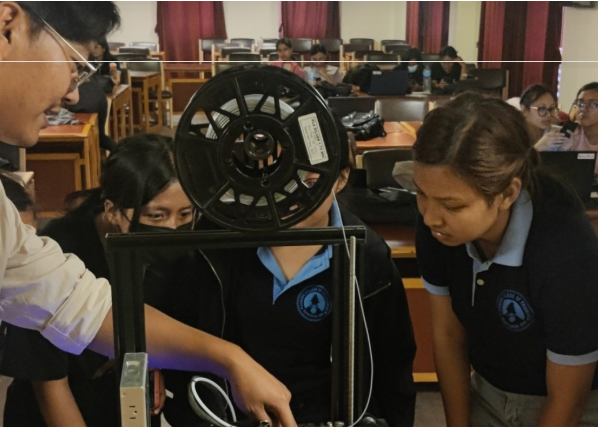
In September 2003, I returned to Nepal after my Manila assignment and checked in on the Robotics Club. They told me what they needed: a 3D printer. I didn’t know what a 3D printer was. But then, Ms. Keepa Mathema stepped in, donating 250,000 Nepali Rupees (a significant sum at the time) to buy one of the first 3D printers in the country. This machine became the lifeline of the Robotics Club. It allowed students to manufacture custom parts, transforming their designs from dreams into reality.
The lesson that endures, etched in circuits and steel, is this: Greatness doesn’t need a grand beginning. It needs a willing heart, a resilient spirit, and the vision to see stardust in scrap metal. Our legacy was never defined by the resources we lacked, but by the resourcefulness we discovered. From the humblest of origins, with passion as the only capital, we proved that you can build not just a robot—but a future.
Highlights:
1999: The unexpected call from Nepal Television sparks the inception of the Robotics Club at Tribhuvan University.
2000: The Japanese team's visit and the 'scrap-yard philosophy' that became the Robotics Club's core belief.
2001: A personal contribution of 10,000 Nepali Rupees helps keep the club’s spirit alive from afar.
2003: Ms. Keepa Mathema's donation of a 3D printer revolutionizes the club’s work and fosters innovation.
Legacy: From humble beginnings, the club rises to global recognition, proving that resourcefulness and passion can overcome any challenge.