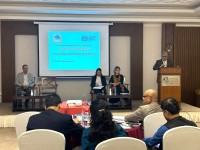
KATHMANDU - One morning in March 2007, I received a note that would lead me into the quiet, high-stakes theatre of Nepal-India relations. It was an invitation from the Ministry of External Affairs of India to attend a high-level dialogue in New Delhi: India-Nepal Relations: Looking At The Future (20-21 April 2007). As a simple professor of engineering at Tribhuvan University, I was surprised. I was even more unnerved when they insisted I present a paper. How did they even know my name? Later, I remembered: an Indian diplomat I knew in Kathmandu was then with a government think tank (Indian Council of World Affairs) in Delhi. The connection was made. The gate had opened.
At Kathmandu’s airport, I met my fellow Nepali delegates—a former minister, senior police officers, noted academics, and journalists. The government of India was footing the bill for us all. We were flown, hosted, and received with impeccable courtesy. It felt like an honour, a recognition. But even then, I felt the subtle weight of the stage we were about to step onto.
The next day, the scale of the forum became clear. Facing us were generals, India’s former foreign secretary, renowned Nepal “experts,” intelligence chiefs, and senior diplomats. The room hummed with authority. The Nepali side was composed of professionals; the Indian side was composed of policy-makers. The asymmetry was in the very design of the chairs.
The presentations began. The Indian side spoke with clarity and purpose. A theme emerged, repeated by several speakers: Nepal could learn from the “Bhutan model,” especially in water resource management. The suggestion hung in the air, polite and profound. I hesitated. Looking around at my senior Nepali colleagues—the former minister, the professors—I saw expectant silence. So, I too stayed quiet, the academic in me wrestling with the citizen.
But the refrain returned. The “Bhutan model.” Finally, I could no longer listen in silence. I raised my hand. I explained, as calmly as I could, that the comparison was flawed. Bhutan’s defence and foreign policy, guided by treaty, were linked to India’s. Nepal was an independent, sovereign nation, never colonised. Our geography was similar, but our history and sovereignty were not. The room grew very still. A debate sparked, sometimes heating up. I kept speaking, realizing with growing alarm that I was now delivering about 70% of the Nepali counterpoints. My distinguished compatriots observed, nodded, but largely remained silent.
Then came the moment I will never forget. A former Indian foreign secretary, a venerable figure, stated a principle of modern diplomacy: “Nothing is free.” A donor, he implied, naturally expects something in return.
My hand was up almost before he finished. “Sir,” I asked, “what would India want in return for its help to Nepal? Should Nepal follow all instructions from India? Should it vote at the UN as directed?” I felt the eyes of the entire room upon me—the sharp focus from the Indian side, the mixed apprehension and curiosity from my own.
I took a breath and spoke not just as a professor, but as a Nepali raised on shared stories. “My father taught me,” I said, “that an elder brother helps a younger one without keeping an account. This is nishkam dharma from the Gita—the duty of selfless action. Is that philosophy still valid in our special relationship?” At that moment, I realised the relation between Nishkam Dharma and Realpolitik in a clash in a Delhi conference room!
The former secretary was a seasoned diplomat. He gave a graceful, non-committal answer about the uniqueness of our bonds. The moment passed, but the line had been drawn.
After the session, a Nepali colleague, the former minister, pulled my wife (she was attending the conference as an observer) aside. “Prof. Shrestha was a bit blunt and direct,” he said, not unkindly. When my wife narrated that observation, I understood his caution. It was the calculus of realpolitik, the fear of closing doors.
I returned to Kathmandu, my mind churning. The most important lesson, however, came not from the debate itself, but from its aftermath. I was never invited to that annual dialogue again.
That exlusion was my final, most powerful lesson. It clarified everything.
An elder brother helps a younger one without keeping an account. This is nishkam dharma from the Gita—the duty of selfless action. Is that philosophy still valid in our special relationship?
The Lessons Carved in Silence: Asymmetry in the Kathmandu-Delhi Dialogue
1. You Are There By Design: Such invitations are strategic. They seek to engage, influence, and assess. Walking in, know your value is also your vulnerability.
2. Asymmetry is the Furniture: The imbalance in representation—policy-makers versus professionals—is not an accident. It sets the subconscious tone of the room. Recognize it, and consciously choose not to be intimidated by it.
3. The “Blunt” Question is Often the Necessary One: Diplomacy is not synonymous with acquiescence. Politeness and principle can coexist. My question about “what in return” was considered blunt, but it exposed the unspoken contract that hangs over aid and diplomacy. Asking it was a duty.
4. The Loudest Sound is Often the Collective Silence: The reluctance of my senior peers to speak up was a cultural and political reality. It spoke of a legacy of dependency, of careerist caution, of a worn-in habit of reading the room for risk rather than for opportunity. Breaking that silence is lonely but critical. Someone must state the sovereign obvious.
5. Exclusion is a Data Point: My subsequent blacklisting from the forum was not a personal failure. It was a confirmation. It proved that such platforms often have a limited tolerance for foundational challenges. They prefer managed consensus over disruptive truth-telling. Consider it a cost of clarity.
A Message to the Younger Generation
To the young Nepali scholars, diplomats, and professionals who will one day sit in such rooms:
1. Carry your expertise like a shield, and your sovereignty like a compass. Master the details of treaties, water flow, and trade data, but never let technicalities obscure the core principle: Nepal’s independence is non-negotiable.
2. Do not confuse respect for titles with submission to narratives. You can—and must—engage, question, and debate as equals. When the “Bhutan model” or any other template is presented, have the historical and legal clarity to deconstruct it. Root your arguments in the bedrock of Nepal’s sovereign journey.
3. And if you find your voice is the only one pushing back in a room full of your own country’s elite, do not doubt yourself. You may be fulfilling the most needed role. Speak your truth with respect, with facts, and with the courage that comes from knowing that true partnership between a giant and a sovereign neighbour can only be built on honesty, not on quiet compliance.
They may not invite you back. But you will have spoken for the dignity of the chair you occupied, and for every Nepali who believes that a “special relationship” deserves a candid, equal, and respectful voice.