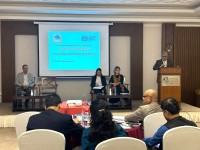
KATHMANDU, January 5 — Nepal and its neighboring countries in the Hindu Kush Himalaya (HKH) region requires $12.05 trillion by 2050 to address climate adaptation and mitigation needs, according to a regional analysis released by the International Centre for Integrated Mountain Development (ICIMOD).
The report, launched at a conference in Paro, Bhutal, reveals that Nepal is among a group of highly exposed nations—including Afghanistan and Pakistan—now forced to spend significantly more than income-group averages on disasters, leaving limited funds for long-term development.
The region serves as a critical water source for billions of people. Researchers estimate the annual climate finance requirement for the eight HKH countries is approximately $768.68 billion. China and India account for 92.4% of the total projected financial need.
"Mobilising the ambitious target of USD 12 trillion is like climbing the Everest of funding," said Ghulam Ali, Innovative Investment Specialist and lead author of the report. "The strategy to mobilise these resources has to be creative, comprehensive, and collective to achieve such significant goals."
The analysis highlights a disparity between climate vulnerability and financial capacity. Countries including Afghanistan, Bangladesh, Bhutan, India, Myanmar, Nepal, and Pakistan are identified as highly exposed to climate effects but least equipped to manage them.
According to the findings, the adaptation burden in the HKH region exceeds global averages. Nations such as Afghanistan, Nepal, and Pakistan are currently spending more than income-group averages on disasters and adaptation, a cycle the report suggests limits funds available for other needs.
The financial pressure varies significantly across the region. Per capita climate finance needs range from $24 to over $2,126 annually. For some nations, this represents 6% of GDP, while for others, it reaches 57%.
“The grounded data this report offers enhances understanding of the actions required to address the financial needs of our region to build economic resilience,” said Pema Gyamtsho, Director General of ICIMOD.
To address the funding gap, the report recommends three primary strategies: Improving access to existing multilateral funds; Pioneering innovative mechanisms, such as debt-for-climate swaps, and Increasing public spending for mountain and environmentally sensitive areas.
The findings were published in the "Climate Finance Synthesis Report: Needs, Flow and Gaps in the Hindu Kush Himalaya Countries."