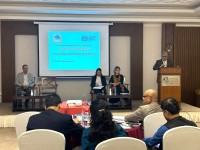
Lalitpur, January 2 — Experts and officials gathered at the Nepal Administrative Staff College (NASC) on Thursday for a high-level seminar analyzed the structure and emerging trends of Nepal’s foreign employment economy.
The seminar, titled "Mapping the Foreign Employment Economy: Nepalese Context," was chaired by Dipak Bharadwaj and featured a primary paper presentation by Madhab Koirala. The session utilized administrative records and unpublished data to outline the recruitment ecosystem and migration pathways currently defining the sector.
According to the presentation, six primary factors drive Nepalese citizens toward foreign employment: an aspiration for prosperity, responsibility and compulsion, imitation or migration culture, perception and delusion, a mismatch between education and domestic labor demand, and a global competition mindset.
Data from the Ministry of Labour, Employment and Social Security (MoLESS) indicates that an estimated 3 to 4 million Nepalese have worked overseas since 2008/09. While approximately 5.7 million labor approvals have been issued in that period, the report noted that many migrants, particularly those traveling to India, remain uncaptured in official administrative records.
The study found that migration is dominated by men aged 18 to 44, primarily from Koshi and Madhesh provinces. Although Gulf Cooperation Council (GCC) countries and Malaysia remain the primary destinations, there is a noted shift toward European nations such as Romania, Croatia, and Malta. While the workforce remains largely low-skilled, the paper identified early signs of a shift toward more skilled employment.
The presentation also highlighted significant risks faced by laborers, including the use of illegal pathways, high migration costs, reliance on informal brokers, and occupational hazards. Weak reintegration mechanisms and migrant deaths were also cited as critical challenges.
In response to these findings, the seminar outlined several policy priorities, including the strengthening of Government-to-Government (G2G) migration channels and improved skills certification. Experts called for more effective regulation of manpower agencies and the promotion of a rights-based, strategic migration policy that improves the tracking and reintegration of returning workers.
Commenting on the findings, Hari Prasad Timilsina noted that Nepal’s economy has become dependent on remittances for daily livelihoods. He suggested the development of a system that links foreign employment with national skills and emphasized the need to create a "reintegration economy" alongside improved governance.
The program was attended by NASC Executive Director Ram Sharan Pudasaini and Course Coordinator Geetanjali Upadhyaya.