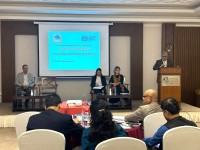
By Masato Kanda, President, President, Asian Development Bank
Education is not only a fundamental human right. It is a strategic investment in our future. It fuels national competitiveness, advances inclusive and sustainable growth, and remains our most powerful instrument for reducing poverty and improving lives. The exchanges this morning reaffirm that we are united by a common purpose: to ensure inclusive, equitable, and high-quality education for all.
Last week, we approved the largest education program in the history of the Asian Development Bank (ADB). A $846 million program will modernize India’s industrial training institutes, benefiting 1.3 million youth, and promoting private sector participation in skills for jobs. ADB is also leading innovative approaches, such as financing Mongolia’s first internationally certified green education facility through private sector lending.
Expanding tertiary education and technical and vocational education is critical. We must build a globally competitive workforce that can keep pace with rapid advances in AI, semiconductors, biotechnology, and green hydrogen.
Three key areas for transformative action
Let me highlight three areas for bold action.
First, we must transform our approach to education delivery by embracing digital formats and artificial intelligence (AI) at scale. AI enables personalized learning, predictive analytics to identify “at-risk” students, and curricula that meet industry demands. However, we must ensure it bridges digital divides, while addressing ethics and privacy concerns, and promote critical thinking of human beings. ADB will continue investing in technology-integrated education to deliver quality education.
Second, expanding tertiary education and technical and vocational education is critical. We must build a globally competitive workforce that can keep pace with rapid advances in AI, semiconductors, biotechnology, and green hydrogen. We need to promote technology transfer and research commercialization while helping higher education institutions diversify revenue sources.
Third, we must enhance private sector participation and public–private partnerships to accelerate innovation by bringing cutting-edge technology, world expertise, and agile implementation that complement government resources.
Together, these three areas will position Asia and the Pacific’s education systems to lead in the global knowledge economy.

Launch of big, bold ideas for the future
The challenge is not simply to adapt to change but to lead it. The next decade demands ideas that link innovation with equity and align learning with growth.
ADB is launching the “Big, Bold Ideas for the Future of Education” initiative at this forum as a prelude to our new ADB Education Sector Strategy for 2035.
In 2026, we will convene a Global Education Advisory Panel of distinguished experts to identify key investment areas where ADB can add the most value. Going beyond usual consultation, we will draw upon leaders from academia, the private sector, and science and technology agencies to translate ambition into action.
ADB’s investment commitment
As global development assistance is declining, ADB is stepping up. From 2025 to 2028, our education commitments are expected to reach $6.5 billion. We look forward to expanding our engagement with partners such as the International Finance Facility for Education and the Education Above All Foundation.
Investing in education is investing in the future. Together, we can leave a legacy of hope and progress as we build a prosperous, inclusive, resilient, and sustainable Asia and the Pacific.
This was a special address by Kanda at the 11th ADB International Education and Skills Forum, 3 December 2025, ADB Headquarters, Manila, Philippines